
Oracle Plans $50 Billion Fundraise to Expand AI Cloud, Boosting HR Tech Capabilities
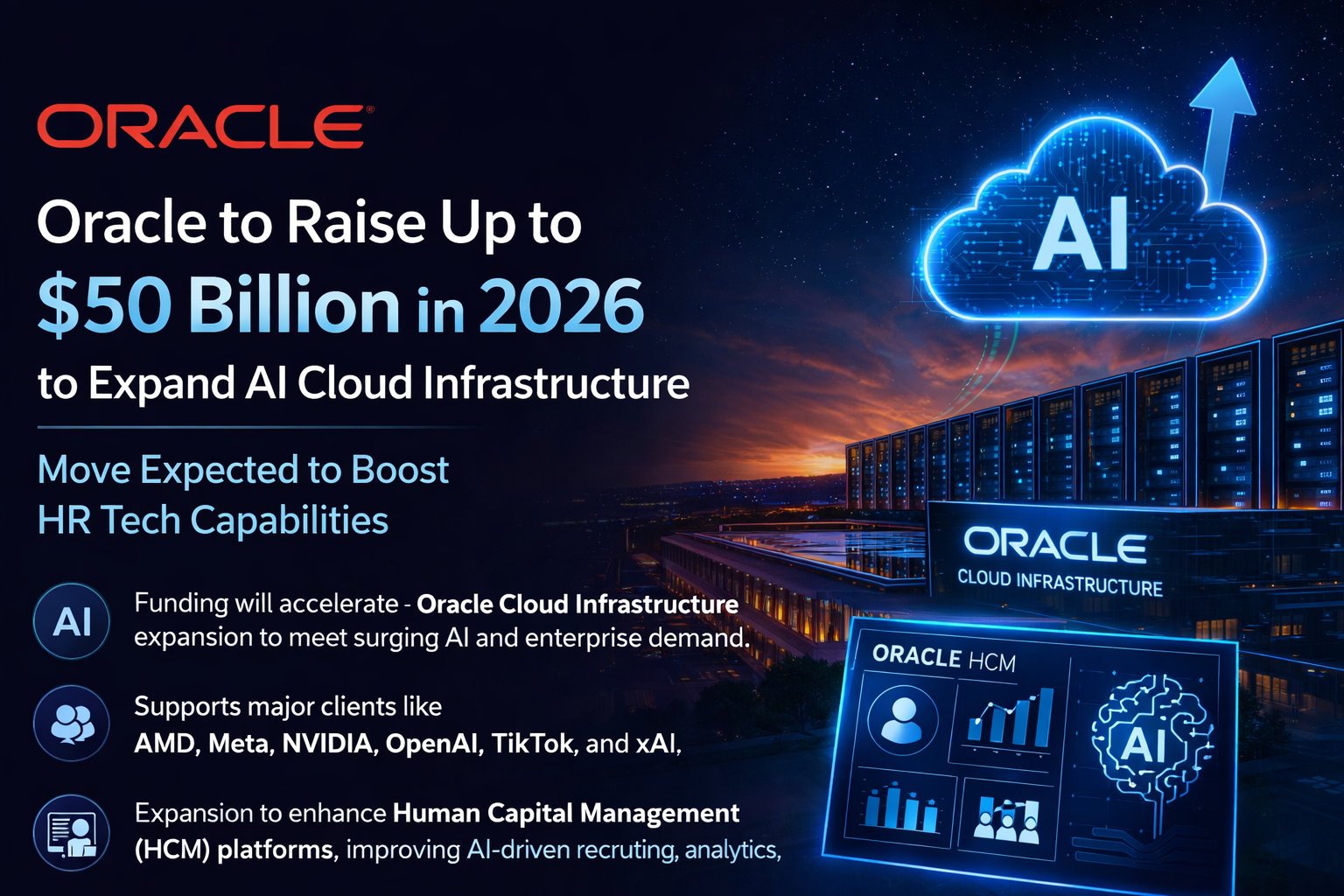
Oracle announced plans to raise between $45 billion and $50 billion in 2026 to significantly expand its cloud infrastructure, a move expected to strengthen its AI capabilities and enhance its enterprise software offerings, including Human Capital Management (HCM) platforms.
In a statement to investors, Oracle said the board-approved funding will support the expansion of Oracle Cloud Infrastructure (OCI) to meet growing demand from major enterprise and technology clients such as AMD, Meta, NVIDIA, OpenAI, TikTok, and xAI. The company plans to raise the capital through a combination of equity and debt while maintaining its investment-grade financial position.
Approximately half of the funding will come from equity financing, including mandatory convertible preferred securities and an at-the-market equity program of up to $20 billion. The remaining amount will be raised through a one-time issuance of senior unsecured investment-grade bonds, expected in early 2026. Oracle stated that it does not plan to issue additional bonds later in the year.
Goldman Sachs will lead the bond offering, while Citigroup will manage the equity program.
The investment is focused on expanding data center capacity to support existing contracted cloud demand rather than speculative growth. Oracle has been increasing infrastructure investments as demand for AI-powered workloads and enterprise cloud services continues to rise.
One example of this expansion is Oracle’s large data center campus in Abilene, Texas, which spans 1,100 acres and includes 4 million square feet of AI-focused infrastructure.
While much of the expansion supports large AI customers, it will also strengthen Oracle’s enterprise applications, including its HCM platform. The same cloud infrastructure that supports AI workloads for companies like OpenAI and NVIDIA also powers Oracle’s HR software systems.
Oracle executives have indicated that 2026 will mark a shift from AI experimentation to large-scale deployment across business applications, including HR systems. Increased infrastructure capacity is expected to improve AI-driven features such as recruiting automation, workforce analytics, performance management, and talent planning.
Industry analysts note that Oracle’s AI capabilities are deeply integrated into its cloud environment rather than operating as separate tools. This allows AI agents and enterprise applications to run on the same infrastructure, improving performance and efficiency.
However, analysts also point out that infrastructure projects of this scale require significant resources, which may influence product development timelines and engineering priorities across Oracle’s software portfolio.
The enterprise software market is increasingly shaped by cloud infrastructure scale, with application performance, AI functionality, and system reliability now heavily dependent on cloud capacity.
Oracle’s planned funding highlights how long-term cloud contracts and AI demand are influencing corporate financial strategies. For HR technology buyers, this signals that cloud infrastructure strength is becoming a key competitive factor.
As 2026 approaches, enterprise customers — especially HR teams preparing to adopt AI at scale — will be watching closely to see how Oracle converts its infrastructure investment into real improvements in performance, reliability, and AI-powered HR functionality.
